Archive for the ‘Kayaking’ Category.

On the purpleness of starfish

Cross-posted from Kayak-Yak.

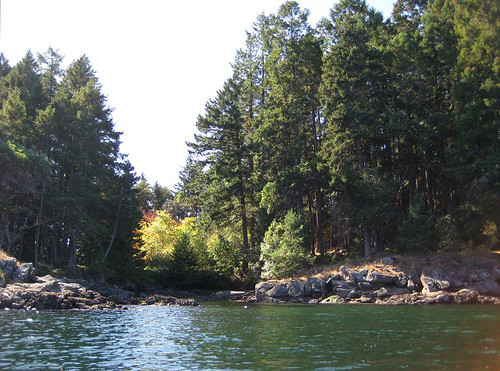
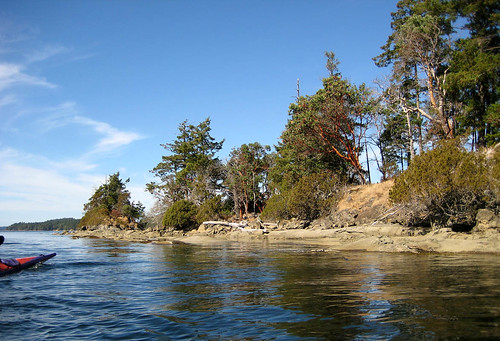
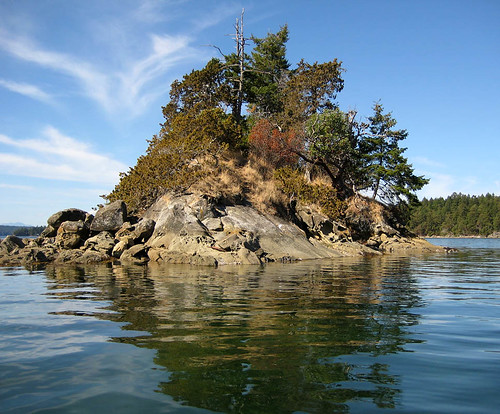
Once upon a time in Brentwood Bay, while drifting over rocks studded with orange and purple starfish, and past huddles of starfish in crevasses at the waterline, it occurred to me to wonder why they were these colours, that purple, in particular. The starfish in question were the ochre star, Pisaster ochraceus, and the answer, after intermittent and desultory trawling through the web and the scientific literature, turned out to be (a) carotenoids and (b) maybe what they eat.

The Royal British Columbia Museum Handbook Sea Stars of British Columbia, Southeast Alaska, and Puget Sound, told me a lot about the anatomy, hunting and mating behaviour, but does not account for the colours: P ochraceus is the most common intertidal sea star, with territory from Prince William Sound, Alaska, to Cedros Island, Baja California (lucky it!), and from the intertidal zone to nearly 100 m undersea. It likes rocky shores, waves and currents. I’ve seen plenty in the Broken Islands, the Gulf Islands, and around Saanich Penninsula. P ochraceus eats mussels, barnacles, limpets, and snails. It is the paradigm of a “keystone species” in that its presence and predation significantly affect the numbers and distribution of other species, especially the California mussel, Mytilus californianus; in the absence of P ochraceus, M californianus takes over the beach. Pisaster spawn in May to July, releasing millions of eggs, which turn into larvae, first floating free in the plankton and then (those that survive) attaching themselves and turning into juvenile sea stars. Juveniles grow to adult size and maturity over about 5 years. Larval P ochraceus have a chemical defense that induces filter-feeders to spit them out (got to look that up). The only known predators of adult sea stars are seagulls and sea otters.

Harley et al, 2006 (full text available) looking at the colour variation, note in their introduction that “at least two caroteinoid pigments mytiloxantin and astaxanthin, sequestered in the aboral surface, produce these colors in Pisaster and other asteroids.” Aboral is the upper side side of the sea star, and starfish belong to the Class Asteroidea, under the Phylum Echinodermata. Caroteinoids as a chemical class are named after their best known member, the yellow pigment in carrots, and have in common a long carbon backbone with many concatenated double bonds which generally absorb light at the blue end of the spectrum, hence the orange colour. Mytiloxanthin was named after M californianus, part of P ochraceous’ preferred diet, from which it was first isolated, so it was assumed to be dietary in origin. Astaxanthin arises through “several distinct metabolic pathways”, and is orange. I’m still not sure from my reading what the pigment behind the purple is, though reading descriptions of 1940s-style chromatography makes me oddly nostalgic for undergraduate chemistry.

However, knowing the pigments doesn’t explain why individual starfish should be orange, ochre, brown, or purple, or why starfish on an exposed, wave-beaten rocky coast like the west coast of Vancouver Island should be predominately orange (6-28%) and brown (68-90%), while those in the sheltered waters of the South St Georgia strait should be almost entirely that brilliant purple so familiar on our paddles (95% in the samples collected by Harley). The answer is apparently not genetic: DNA studies don’t suggest that the populations sampled (from Alaska to California, with lots of attention to Puget Sound) are isolated from each other, and conversely do suggest that there is flow of genetic material between them. It’s not apparently to do with wave action, inasmuch as scientists have been able to reproduce in the lab the difference between turbulent water and calm. It may be dietary, in that the distribution of colours correlated with the pattern of prey: in the more exposed waters (where purple starfish are in the minority), P ochraceus preferentially eat M californianus, the big California mussel, whereas M calfornianus is uncommon to absent in interior waters (where purple starfish are in the majority), and the Pisaster there tend to prey on barnacles and bay mussels. So, eats purple mussels -> orange; doesn’t eat purple mussels -> purple. Hmm. And that still doesn’t explain why purple and orange starfish could be found within yards of each other. Another paper by Raymondi et al, 2007 (only abstract) found that the frequency of orange in a population was constant with latitude, but tends to increase with the size of the individuals in that population. So all is not quite explained.
References

  • Harley CDG, Pankey MS, Wares JP, Grosberg RK, Wonham MJ. Color Polymorphism and Genetic Structure in the Sea Star Pisaster ochraceus. Biol Bull. 2006 Dec 1;211(3):248-262. And here’s marine biologist Christopher Mah (full name from his Twitter feed), on the Echinoblog, with a crisp and colourful synopsis, complete with photos and diagrams; if I hadn’t written a chunk of this entry while back before I found his entry, I’d just have said, go there!
  • Lambert P. Sea Stars of British Columbia, Southeast Alaska, and Puget Sound. 2nd ed. UBC Press; 2000.
  • Raimondi PT, Sagarin RD, Ambrose RF, Bell C, George M, Lee SF, et al. Consistent Frequency of Color Morphs in the Sea Star Pisaster ochraceus (Echinodermata:Asteriidae) across Open-Coast Habitats in the Northeastern Pacific. Pacific Science. 2007 4;61(2):201-210.

Making believe it’s June

(Cross-posted from Kayak Yak)

Starting back into the regular Monday-Friday routine concentrates the mind. Forecast of 10-15 westerly knots (again) notwithstanding, it was paddle Sunday or not at all, and the day that I got made me regret all the similar days I passed up.

(But I am not gloating, really, only on this particular day, the east won.)

It was Parc de la Rivière again: Bixi to the Metro, Metro to Cartier station, STM 73 bus in the direction of Fabreville – Laval, bless them, puts the direction of travel on the buses, unlike Montreal. Arrive just after 9 am in noticeably slanted morning light at the Embarcations, and stake my claim on a Kayak de Mer, the doughty orange Kasko.

I’m ashamed to say that I’ve only paddled the Parc once this summer, back in mid June, the continually taunting weather reports having fed into my third-book-and-trilogy completion neurosis; I kept procrastinating, waiting for a day with no wind forecast. When I was out in June I was impressed by how low the water already was. It made me appreciate that last winter had been dry. Last year in the early summer I was able to paddle through trees (and get munched on by flies), and venture into the marsh; this year, even the turtle pull-outs were well up the bank, the marsh was impassible beyond a short, narrow channel, a number of shortcuts, like the one out of the lagoon in front of the launch site, were above the water level. I’m simply not used to the water going away and not coming back 6 hours or so later. I found myself thinking that the originator of the expression ‘letting the grass grow under one’s feet’ as a measure of indolence had not observed river grass invading an exposed bank. There was no way of telling from the grasses alongside the river that that part was underwater a year ago. Today it was even more of the same. In a lot of places, if I’d tipped, I’d have been sucking mud, and if I’d banged my head on a rock, I might have been rediscovered like Lyuba, the baby mammoth in a million years or so. Although when I did wobble interestingly, it was because I was probing for the bottom with my paddle in what turned out to be a deep spot.

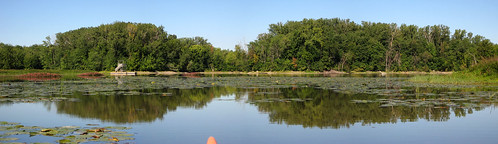
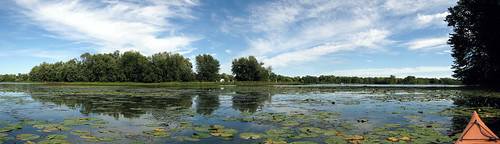
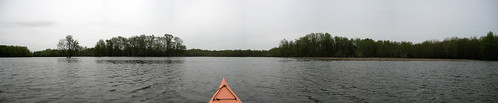
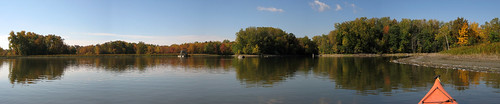
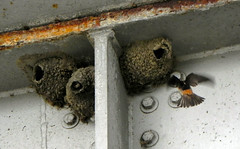
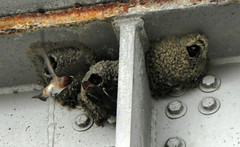
I took what has become my usual route, out the east end of the lagoon, and past Île Gagnon, where the water was extremely shallow, the bottom muddy and rocky, and I was conscious of tucking my tailbone up in anticipation of the grinding beneath. Up the south side of the river, under the Autoroute des Laurentides and the footbridge to Île Locas, checking out the completed swallows nests on the underside as I went – I’d watched the foundations being laid when I was out in June, beakful by beakful of dark river mud, trying to figure out whether one plan ruled construction or not. And then on to the marsh. This post was nearly entitled “500 geese, a dozen herons, and me.” This panorama, taken from beside the lookout on the edge of the marsh, should give the idea (note, those speckles are geese).

Parc de la Rivière-des-Mille-Îles

I let myself drift very slowly through a gap between goose-gangs, and discovered a dredged channel leading into the marsh, which terminated abruptly in a wall of black mud and sticks. I don’t think beavers were involved. If they were, no waterway is safe.

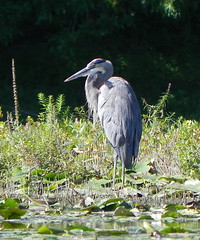
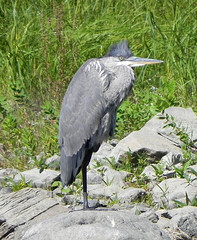
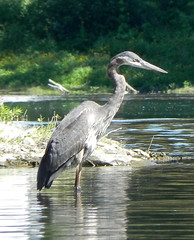
As last year, the great blue herons were out of their usual exclusive neighbourhood in the marsh, and scattered up and down the water’s edge west of des Laurentides, each one apparently aspiring to solitude. They seemed touchier than usual, and though I wasn’t trying to spook them, even when I swung over to the other side of the channel it didn’t seem far enough. Though there was the one I came on as I rounded a bend; it froze, I froze, and we played statues as the wind pushed me gently past and away. I also spotted a number of kingfishers dashing between islands, and some small white-bellied shorebirds I could not identify. No swallows, scattered dragonflies, and whatever moved beneath the water’s surface was safely hidden in mud. The water-lilies were looking tattered and tired, and there were scattered mats of purple river-plants.

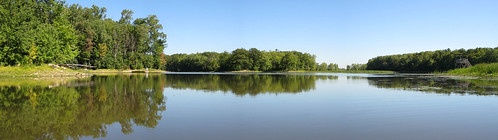
Wind, yes, there was wind, intermittently. But there were spells of calm, allowing full appreciation of the flotillas of round cumuli proceeding overhead with perhaps just a little too much despatch to be stately. This panorama was taken at the furthest west extent of the Parc, at the tip of Île de Mai looking west. One day I shall go beyond …

Parc de la Rivière-des-Mille-Îles

I rounded the tip and came down channel between Île de Mai and Laval, brazenly floating down the middle of the channel while munching on a roasted mushroom and chevre panini, something I’d never have dared do in the middle of summer. I paused to admire and take pictures of a weeping willow planted above a wall and draping down almost to the water. While I was doing that, the first power boat of the day passed by, sending the water sloshing and my kayak rocking. Then I swung back over to make a pit-stop on Île Chabon, muttering ‘I must do more of this’ as I floundered to dismount onto a steeply sloping beach. Two or three canoes had reached the lookout and the geese had scattered. Then I paddled back the way I had come through the channel towards the des Laurentides bridge. I was well into my fourth hour and a day rental, so I paddled around the north side of Île de Jiufs, but had decided to cut myself off at 5 hours and get the 2:30-something bus, so back into the lagoon, which was crowded with single and double kayaks and two person canoes, heading out to enjoy a gorgeous warm afternoon. Would that it had been June!

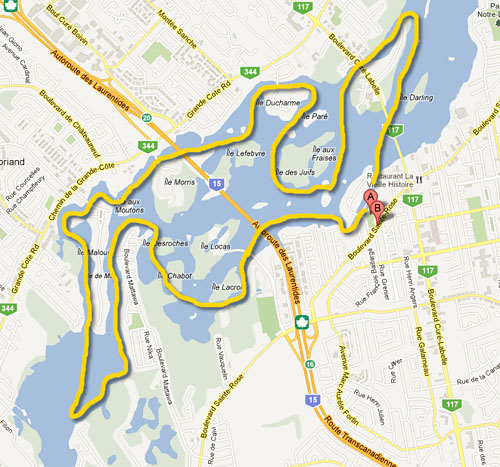
My fake GPS plot – just Alison ‘taking a line for a walk’ as we used to call it in kindergarten. Unfortunately, I can’t recall where I got this image from, or I would have updated it to show the difference between then and now.

A perfect day in eastern paradise

Cross-posted from Kayak Yak.

ParcdelaRiviere_07Sept09_2_400v

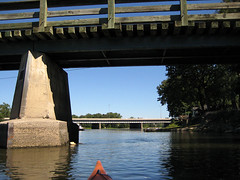
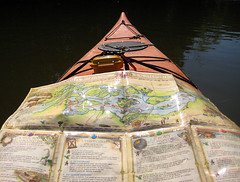
Perfect days don’t just happen in the West Coast Paddling Paradise – sometimes they happen here in the east. Today’s forecast was for calm until the afternoon, then 10-15 knot SW winds, and a high of 25 C, and that is exactly what I got on today’s trip to Parc de la Rivière-des-Mille-Îles (actually my fourth). Despite a technical hitch involving my Opus (Metro) card and a missed train, I was at Cartier station in plenty of time to catch the 0829 #73 bus and discovered to my pleasure that the #73 was no longer on diversion prior to the Parc, the resurfacing on pont Marius Defresne (the right-most bridge on the map) having migrated south of the intersection with boulevard Ste-Rose . I alighted at the Parc gates, was just about first up to the counter to rent a kayak de mer, and paid attention to the paddle (feathered), the seat (snugly fitting with solid back support) and the footrests (adjusted to my height), all of which I’d neglected to check the last time I was out (last Monday). I let myself drift off the dock while I made sure I found the panorama settings on the Olympus waterproof – I’d decided that traveling with two point and shoot digitals and one film camera was maybe a little excessive. Then I headed north-east out of the entrance of the lagoon, around the tip of Île Gagnon on water that was so glassy the kayak just slip-slid along, every so often twitching with a fillup of river-current. The skin of the water was alive with tiny water-beetles, like tossed handfuls of blue-black seed-beads.

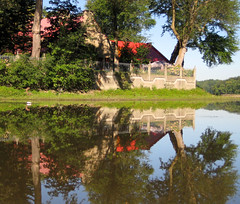
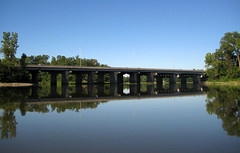
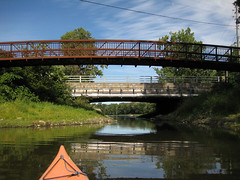
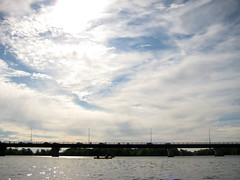
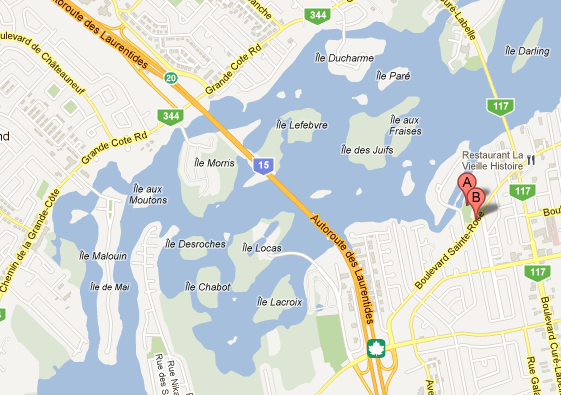
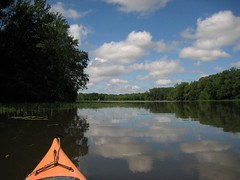
Mirrored clouds above the bridge of the autoroute de Laurentides, QuebecPausing frequently to take photographs, I moseyed up in the direction of the wetlands area I’d discovered in my first trip back in July. At the time I set out, the sun was filtered by a thin film of cirrostratus, with denser streaks of cirrocumulus; it looked like the weather was changing, but by the time I reached the wetlands, the cirrostratus had cleared and the sun was alternating bright sunshine with the shadow of small cumuli, and in the four and a half hours I was out, the clouds – small cumuli and cirus – gathered and dispersed several times, none of the clouds dense or substantial enough to more than dim the sunlight. The wind, as forecast, did not pick up until close to noon, at which point I was paddling south against the current on the west side of Île de Mai, the long island running north-south at the left of the map.

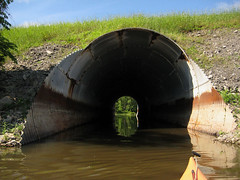
I’ve been out four times now, twice in July, once at the end of August, and today. The water-level has appreciably dropped, such that the flooded stand of silver maples I got to paddle through in July (nourishing the resident flies in the process) were quite dry and aloof to the water now, and the hairpin between Île des Jiufs (how I read it on the map) and Île aux Fraises (both north-west of Île Gagnon) was because I got all the way through and found the channel blocked by a ridge of toothy boulders and the branches and debris they had strained out. A large culvert beneath the peninsula that carries the autoroute des Laurentides (the second river-spanning bridge) was also impassible due to a snag. I had more scrapes and grounded out my paddle more often today; on the up-side, a summer’s growth had brought the weeds very close to the surface, though they were too thick with algae and mud for me to recognize more than ribbon-shape or branching brush-shape. And as I paddled down to the south of Île Lacroix (just east of the marshlands) on my return I was able to look down and see schools of tiddlers scattering at the vibrations of my passage.

I’d meant to go into the marshlands, as I did in July, but there was a great blue heron fishing in the shallows just beside the one barely navigable channel – I’d made it a little way up that channel on my last outing, but between the water level sinking and the summer’s growth of reeds and weed, it was only a little way. So I stood off and watched the heron prowl along the edge of the reeds. There is something catlike about them, with the stillness, the hunkering low, the pounce – and the little ruffled insouciant shiver as they collect themselves after a failed strike. There were ducks aplenty, mainly mallards, browsing in pairs and more often than not standing tails to heaven in the still waters. I caught sight of a single kingfisher, a flash of white against the trees, and later on saw two flying between islands, squabbling all the way – are they territorial birds?

After the wetlands, I wanted to circumnavigate Île de Mai, the recommended way this time. The second trip I made in July, I looped out on the west side of the island and nearly did not make it, hitting what I suspect was an underwater bar within sight of the end. It was also the day after severe thunderstorms, when the water was murky brown and running fast, and there were downed and split trees all along the channel. I came to a standstill, paddling full-force, and had given up and was drifting downstream when in a fit of cussedness I decided to try the other side, crossed over, and succeeded in paddling through the stall, though literally gaining an inch at a time at one point. I was consoled that a two-person canoe whom I passed on my downstream drift, wound up doing exactly the same. It wasn’t until I got back that I looked at the Parc guide and saw that the marked route went up the east side and came down the west. So this time I did it the easy way. No stalls, though some churning water off Île aux Moutons (the small island north east of Île de Mai, and definite current, then wind. A small culvert underneath that promontory was open this time, and I paddled against the wind and the current up to the open waters, where the powerboats were churning in circles. Those coming through the channel kept their speed down, with one exception, a white powerboat that came crashing past Île de Moutons as I was starting up the channel, steering between a pair of kayaks. The buzzed kayakers coped all right, but a couple of others in the vicinity were visibly uneasy being bounced around in the reflected waves.

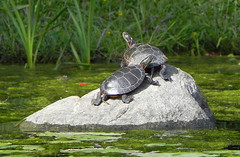
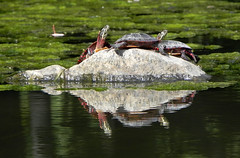
Waterplants in bloom, Parc de la Rivière-des-Mille-ÎlesHaving made it to the tip of Île de Mai, I got to ride down with the wind and current, and when I hit the point I’d hung up before, I got a brisk kick from behind, much easier going north than south. I needed a pit-stop, so I turned back to Île Chabon, which was marked on the map as having latrines, and, since there was no helpful signposting, walked three quarters of the way round the island before finding the sign and the hutch in the wood (with toilet paper, too). On the sunny side of Île Chabon, the turtles were out once again, warming themselves on fallen logs and rocks; I still don’t know what kind they are, not having been allowed close enough. Then I headed down through the weed-clogged channel south of Île Lacroix, tiddler-spotting and being buzzed by dragonflies, large black and smaller bright blue. Ducked under the bridge to Île Locas, avoiding fishing-lines slung from the bridge, and under the long autoroute de Laurentides bridge. Decided that I was not going to make it back within the four hour mark and I might as well be hanged for a sheep, etc, so detoured across to try and navigate the channel between Île de Juifs and Île aux Fraises, and found it blocked, so I then doubled back around the western tip of Île Gagnon, under a bridge into the lagoon, and found it milling with boats as the holiday monday afternoon canoists and kayakers and peddle-boaters all turned out. Lingered in the Interpretation Centre until my (hourly) bus was due, puzzling out the descriptions of the river milieu in French and writing down names of plants to look up. Aside from the water-lilies, one of the water-weeds was flowering, small dense pink flowers on conical stalks, forming mats along the edges of the reeds, downstream from the islands, and even at shallow points in the middle of channels.

More photographs to follow in my Flickr collection. For now, I must acknowledge the imminence of Tuesday.

Paddling with an accent (Parc de la Rivière-des-Mille-Îles)

Cross-post from Kayak Yak.

On Sunday morning, admittedly quite a bit later than I had originally intended, I tossed a bunch of stuff including a pack lunch and a water bottle into my mesh MEC bag, and headed for Parc de la Rivière-des-Mille-Îles in Laval, an hour away by bus and Metro. Quite a straightforward trip, out to the Cartier Metro station, and transfer to the STL bus number 73, only hitch being that since it was Sunday morning, the service was hourly. Made the transfer, with room to spare. Fortunately when I saw two different entrances to the Parc, one for summer, one for winter, I had the wit to check with the bus driver, which was just as well, because the bus was on a detour and hung a left about 5 minutes walk before the Parc. So I hopped off the bus, climbed between the concrete bollards and across the stretch of denuded road and continued as directed, and found the Parc, the Interpretation centre, and signs to the rental centre, all right beside the road.

Skipped through the Interpretation centre, already seeing water and many boats of various colours and morphologies, joined the rental queue and managed, between my basic French and the agent’s basic English, to acquire a paddle, a life jacket, and a slip of paper that I was to take down to the water side. Slip of paper was shortly exchanged for a Boreal Kasko, orange plastic, at which I admit I looked a little askance, as it looked like it had been rode hard and put away wet, and I had doubts about the grey putty on the tip of the keel and the bulge aft of the seat. But the seat was comfortable, the foot rests needed no adjustment, and hey, it was a kayak and it was mine, all mine (at least for the next few hours). Once on the water, it felt not unlike my much-missed Kestrel.

Parc de la Rivière-des-Mille-ÎlesParc de la Rivière-des-Mille-Îles

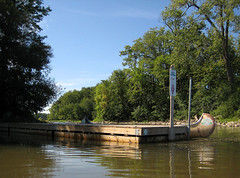
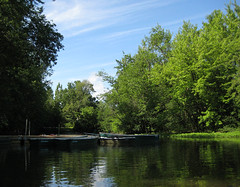
I launched off a nubby dirt, stone and root patch no longer than the Kasko. There was a dock for the larger kayaks, multi-person canoes, and pedal-boats. I was offshore before I realized I couldn’t feather my paddle – it wasn’t going to twist that way – but I didn’t have any trouble adjusting. The launch was in a kind of lagoon [1] – looked as though a gap between two islands filled in at one end, so first I had to work my way out of the lagoon, around the corner, into the bay. It was already near lunchtime, and a bit breezy, so I paddled into the lee of an island, and parked in the shade of a willow tree to eat [2], periodically adjusting against the slight current and watching other craft go by. From the perspective of the single kayaker, there is something unintentionally hilarious about the sight of one canoe with 9 paddles all wagging at different rates and different angles. The high was forecast to be 23 C, the sky was piled up with big plump clouds, the sun was unfiltered by smog or moisture, and – only hitch – there was a breeze of up to 40 km/h forecast.

After lunch, I followed the route that all the other boats had taken, through a narrow gap between islands and then across through a channel between islands [3]. Dragonflies aplenty, from modest sized black ones, to the large metallic blue ones, all as impossible as ever to photograph. Went all the way through, decided I didn’t want to wind up back at the start quite yet, so doubled back. As I came around the side of that island, I met the strongest gust of the stiff wind that had been forecast, and for about 10 minutes made very little headway, but the wind gave up before I did , and I crossed over and worked my way up the side of Ile Lefebre, hugging the edge and watching the reeds. At one point I noticed some reeds almost at the shore twitching and thrashing as though there were a fight going on between a couple of somethings in there. Couldn’t see what, so hung around, watching the twitches getting closer to the water, thinking must be a water-bird but surprised, as it got closer to the water, that I was still seeing virtually nothing. Then just at the edge of the reeds, the water suddenly heaved and a curve of grey scale briefly appeared as the fish slithered over an underground obstruction. It was a large carp, at least a foot long, with a long orange-rimmed maw. Tried for some photos, but you’d need imagination to believe that smear was a fish’s spine, and I wasn’t going to sink the camera into these waters. Remember those carp. They’re going to come up again.

Parc de la Rivière-des-Mille-Îles panorama

Parc de la Rivière-des-Mille-Îles panorama

So I kept paddling along, up a stretch that was reminiscent of the stretch of the Gorge above Selkirk Trestle, with houses and docks along the water’s edge, up and around a rather posher-looking stretch [5], and one of my two panoramas, and into the area marked 6, which is shallow waters, reeds and wetlands, site of the second panorama.

Parc de la Rivière-des-Mille-ÎlesParc de la Rivière-des-Mille-ÎlesParc de la Rivière-des-Mille-ÎlesParc de la Rivière-des-Mille-Îles, Red winged blackbird

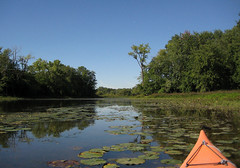
Parc de la Rivière-des-Mille-Îles, HeronThe first part of the paddle had proceeded to the constant accompaniment of heavy traffic over the bridge, but in the wetlands the traffic noise had faded to a subliminal hum, and the main sound was birdsong, especially the red winged blackbird. It was possible to nudge the kayak gently through the reeds, deeper into the marshlands. I caught periodic glimpses of waving paddles above the reeds, encouraging me to keep going. I found my way into a small clear area, full of lily pads, and was so intent on the few lilies that I nearly missed seeing the heron, by which point the heron had assumed that stretched-neck on-point posture that told me it was disturbed. I shipped the paddle and drifted, trying to look like a (friendly, big, orange) lily pad, but the big bird had had enough of my ill-manners and flew off in its slow, stately manner. So I started working my way back towards where I’d seen the paddles, following the voices, and screeches and squeals of fright. I met the group coming back through the reeds and the first thing the lead paddler asked me was had I seen the carp. Yes, I said, a little bewildered, but not here. I soon found out what she meant, and why the shrieks. I’d be innocently paddling along, and from the side there’d be a watery thunk and a great swirl as a bolt of fishy muscle turned on its tail and plunged into the reeds. Oh yes, it would make a great opening scene, under a bright blue sky with big fluffy clouds, what could be more innocent, kayaker paddling peacefully through the reeds, glancing curiously at swirl in the water, sudden truncated scream, shot of empty kayak drifting away …

Well, nothing et me, since I’m here to report. I followed some channels through the reeds, hoping to work my way round the island in the centre, but reached a point where the channels disappeared and the reeds continued. At which point I spotted something white flickering deep in the reeds which I made out as the head of a heron. While staring at that one, I initially missed seeing the second, more visible, heron off to the right of me, long neck extended, showing the white stripes up its neck and white flash above the eyes. I was determined to show some manners this time, and very carefully turned the kayak around in the reed channel, and tiptoed, kayak-style, away through the reeds and small trees, out into the main waterway. Then I wandered off down a channel that I thought should take me back in the direction I wanted to go, only to meet a bridge that I was sure I had not come under: it was far too narrow, and people were fishing off it, and I have a horror of fish hooks getting stuck in any part of me [7]. So I turned around and slogged back, meeting the breeze, reassuring myself I still had over 2 hours to find my way back before the rentals closed, found the floating lookout station, and worked my way around to the channel I knew I had come up and the bridge I had come under. The open waters were much busier now, with power-boats and jet-skis doing their thing, and a bit of wake to bob around in. By then my shoulders had quit merely grumbling and were threatening concerted industrial action, and I had been out on the water over 3 hours, so I paddled my way back to the lagoon, and turned in my boat. I’d been out long enough to graduate from the $11/hr to the $37/day rental. I had to pass through the Interpretation Centre at a gallop, only long enough to murmur appreciatively towards a grass snake that one of the attendants was showing off, to make my (hourly, remember) bus. Which was a shame, because I would like to have checked up and been able to put names to what I’m seeing. But I am most definitely going back.

Here’s the site for the Parc, en Francais. I tried hacking around the URL to see if I could find an English version, but there doesn’t seem to be one.

Broken Islands trip page

Last month, I took a five day kayaking trip to the Broken Islands in Barklay Sound, off the west coast of Vancouver Island. It was something I’d been talking about for at least six years, despite the fact that I have only spent one night of my adult life under canvas. Since then I’ve been editing photos and working on and off on a trip report that just kept getting longer and longer as I remembered things and looked up details. It was just about an ideal trip. The setting was beautiful, ideal for kayaking, our guides were capable, mellow and entertaining, the group just gelled, and after the rain and wind of the first day, the weather was as good as it gets in September on the west coast. And everywhere we turned, we saw a whale. Here’s the full trip report: Broken Islands trip page.

And should anyone wonder: yes, my missing sock reappeared.