Thought in response to Jo Walton's blog post on the Left Hand of Darkness and the ensuing discussion: To me the question at the center of Left Hand of Darkness was always, 'if you take away gender, what's left' – or as Le Guin herself put it it 'is gender necessary'. Which makes it a touch ironic that it has come to be seen as the prototypic book 'about' gender. In my course, a few years ago, on a history of Modern Europe, I was introduced to the concept of 'enclosure' as a societal strategy for managing disruptive elements – it seems to me that Le Guin practiced a kind of narrative enclosure of gender in LHD in her invention of kemmer, to free her to write about other things. What went out were aspects of the masculine, epitomized by warlike behavior, but also certain aspects of the feminine (a thought I must unpack further). What remained were politics, culture, creativity, imagination, love, vision and sacrifice, not even the complete list but already a grand lot.
Category Archives: Science fiction
Thank you, says the voice from the hole
This is the first month’s anniversary of Darkborn’s publication, and last night I did my first Google search on the title and noted that a number of people have already reviewed it. I’d like to thank you all. Even if you didn’t care for it, I still very much appreciate the time and attention you put into reading it, thinking about it, and writing about it. And of course, if you did like it … well, I’m human (when not being something else for literary impersonation purposes), susceptible, and even more appreciative.
I’m afraid I’ve been rather un-interactive; in fact, I more or less jumped in a hole and pulled it in after me. The first three novels I published were not only in the early days of the internet but stand-alones. By the time Legacies was published, I was deep in Blueheart. By the time Blueheart was published, I was trying to subdue Cavalcade. When I received reader and reviewer feedback, it was on a story that was completed in my mind and characters that had safely arrived, deservedly or undeservedly, at their destinies. Not on a story that was still working itself out and characters that were still developing. I had one critical comment pre-publication, quite offhand and definitely not intended to have the effect it did, that made me realize how easily my nerve could fail me in taking the trilogy where I want it to go. (I usually know where I want my characters to end up early in the writing, but the getting there is rather like the famous cartoon of the mathematical proof on the blackboard that has, in the middle, “And then a miracle occurs”.) So I’ve been – and continue to be – a bit skittish. Particularly since, instead of establishing the trajectory for Shadowborn over the summer, I’m in the midst of what has turned out to be a complex and substantial rewrite of Lightborn.
But it’s time to bunt myself out of the hole. Start Twittering again (I’m alixsinc – note the c – on Twitter and alixsin on identi.ca). Turn comments back on. Post photographs. Tidy up the blog. Finish posts and book-notes that are cluttering up my hard drive. Get over to tor.com and chip in my 2-bits-worth on some of their fascinating articles. Get the website upgrade done, which involves making a final decision on Dreamweaver (if it will condescend to accept my license key), Dokuwiki, or WordPress as the publication engine. So many more options since I first learned basic HTML. Can’t promise much over the next month, alas. Aside from Lightborn, I’ve summer courses in pharmacoepidemiology and Bayesian statistics. And I mean to get myself into a kayak at least once a week, before the water freezes once more. And since I’m in Montréal, I have a natural deadline to climb out of my hole: Worldcon 2009, Anticipation. Going to be fun!
Updates over at SFF net
Oh shame, shame, when a website update is worthy of a blog post. It’s been far too long. But the forbearing people at SFF.net have reinstated my SFF.net page after I let my payment method expire, so I took the opportunity to update, do a minor restyling, clean up some CSS and dust off a couple of older pages. More to be done, later. I am again convinced that some twisted minds are behind CSS positioning.
A mannerly dance (The Phoenix Legacy)
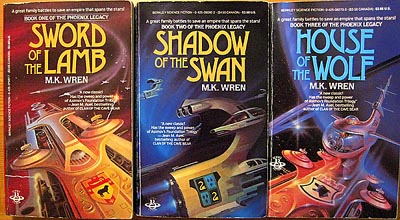 I’ve been looking for a word to describe the particular narrative flavor of MK Wren’s trilogy The Phoenix Legacy (Sword of the Lamb, Shadow of the Swan, and House of the Wolf, all first published 1981), and failed to find it, though I’m sure it exists. I’m sure there’s a dance in which the stances are as important as the movement, and in these novels, the moments of reflection are as important, if not more so, than the action that – often off-stage – precedes them.
MK Wren has described the trilogy as an historical novel set in the future. The dominant political entity is the Concord, a neo-feudal political entity spread across multiple planets, in which a small Elite rule over the Fesh (professionals) and even more numerous Bonds (serfs). The trilogy is primarily the story of Alexand DeKoven Woolf, grandson of the Chairman of the Concord, and son and heir to one of its leading families. An educated, thoughtful young man, Alexand is unable to remain oblivious to the instability and fear that is eroding the Concord, with recurrent Bond uprisings met by increasingly brutal repression. Through his scholarly, sensitive brother, Richard, he becomes aware of the Society of the Phoenix, founded a generation ago by the leader of the defeated Peladeen Republic and a group of primarily Fesh revolutionaries dedicated to bringing about an evolution of their society. Richard, already mortally ill, is convicted of treason for his membership and submits to a martyr’s death in an attempt to offer a model of submission to the Bonds. When their father rejects Richard’s sacrifice, Alexand realizes his own political impotence as mere heir, stages his own death and assumes the identity of Commander Alex Ransom of the Phoenix’ military arm. In joining them, he offers the Phoenix an eventual entry into the Elite, provided he survives, and provided he can be restored to his former status. The remaining two books depict the working out of Alexand’s destiny, with repeated betrayals of Alexand and the Phoenix from within that lead him eventually to the same execution platform that his brother died on, years before.
The story and characters are engaging, though perhaps too black and white. The good are fundamentally good and the evil fundamentally evil. Good people may oppose each other – as Alexand’s father does Alexand – but ultimately make the right choice. Love offers salvation, for both Alexand and the assassin Bruno Hawkwood. The patriarchal, feudal society leaves too little latitude for Alexand’s brave and clear-eyed beloved, Adrien Eliseer, to act, so her part of the story is somewhat unsatisfying, though the more egalitarian Society of the Phoenix produces physician Erica Radek and young radical Val Severin. In her flaws and fallibility, Val is one of the most interesting characters: manipulated to betray Alexand, she then strives to redeem herself in her own and his eyes.
I mentioned the distinctive narrative strategy. SF novels commonly use quotes and excerpts from documents that belong to their fictional worlds, though I’ve seldom seen it done so intensively as here. There main story is interspersed with numerous interpolations of personal, historical and sociological documents, mainly as written by Richard’s various aliases, historian, sociologist and Phoenix agent. They fill in some fifteen centuries of back-story, but also introduce several key historical figures, the most important being Lionor Mankeen, who fought a failed war of liberation against the Concord, and Elor Peladeen, founder of the conquered Peladeen republic, whose stories are set against Alexand’s as alternative destinies.
And I mentioned the rhythm of the narrative as being like a mannerly dance, in which the stances are as important as the motions. Each chapter is a single scene, encompassing a relatively brief interval in time, and that moment is often as not the moment of reflection after a revelation or an action, rather than the revelation or action itself: the death of Ivanoi and his family, the death of Elise Galinin Woolfe, the capture of Andreas and Alexand, the meeting in which Adrien pleads with his father for Alexand’s life – all are described in retrospect, as the viewpoint character grapples with the emotional and political implications. We are given only a brief, intense glimpse of a terrified Rich in hiding during a Bond uprising, which proves seminal in his determination to enter the Phoenix – though a longer, first-person description is provided in the very first pages of the book, through one of the interpolated documents. The Phoenix’ brief war with the Concord is depicted entirely from the perspective of a non-combatant, Predis Ussher, traitor and usurper. Two purposes are achieved: a unity in the account, and an inside look at the destruction of the dream of conquest. It’s a distinctive approach that emphasizes interior experience over physical events. It gives the novels a romantic intensity, but also a sometimes offbalanced stillness that is certainly contrary to current fashion, and may not be to everyone’s taste. I like it, though.
Con Report: Con-Version 23, August 17-19
(Cross-posted from Reality Skimming.)
It seemed to come together late for all concerned, but it came together: Con-Version 23. I’d decided to be a lurker at this con and not volunteer for any panels, and I headed over to Calgary a day early to have a chance to hang out with Rebecca Bradley (science GOH) and Marie Jakober. Coming in to land from the north, I didn’t get much sense of Calgary’s growth, which I am assured has been prodigious; it was certainly as green as the coast, testifying to a wet summer. No mosquitos, because of the cold, change from Westercon.
First event, after a side-trip to the UofC library to polish off a little work, was Rebecca and Robin’s party, attended by the Con GOH Jack McDevitt, the singing IFWAns (more about them later), Edge notables and assorted others such as Marie and myself. Though blurry with fatigue (How can someone get jet-lagged on a 1 h time change? – I blame the altitude) I was up until midnight, having fascinating back-deck and buffet-table conversations on a huge range of subjects, and eating too much of the yummy food. I finally got to thank Jack McDevitt for giving me my one and only Nebula award nomination, years ago, for Blueheart. Lynda Williams, Jennifer Lott (Lynda’s daughter) and Nathalie Mallet arrived from PG around 9 pm, all full of beans despite having driven all day.
The Show’s Not Over ‘Till the Captain Sings
The con itself kicked off the following evening, with the opening ceremonies, which I skived, and with the musical: “The Phantom of the Space Opera”, which I am very pleased I did not, though I arrived after the start and missed seeing the chair at the front Marie had saved for me. Stood at the back, and took digital pot-shots of the action, most of which turned out blurred. Either the subject was dancing too hard, or I was laughing too hard.
In brief, the story involves the crew of the Starship Insipid, captained by one Captain Quirk, who endure a visitation by the Phantom of Space Opera (Steve Swanson), who is searching the galaxy for musical talent. One by one, in a desperate attempt to avert the consequences of having the Captain sing, the crew take turns trying to impress the implacable Phantom. Dr. Temperence “Bones” Brennan (Rebecca, perfectly typecast) standing in for Dr. Leonard “Bones” McCoy, alas can do little for the mounting casualty count, declaring “I’m the lady who loves bones” and delegating the disposal of the inadequately skeletonized remains to Nurse Chapstick (Colleen Eggerton). Which works fine until Amanda Grayson (Danita Maslan) reveals she was standing in for her son Spork, who has returned to Vulcan on account of Ponn Farr, at which point Nurse Chapstick, who has been waiting SEVEN LONG YEARS for this, demands the keys to the space shuttle; Phantom or no Phantom, dead redshirts or no dead redshirts, she’s Vulcan-bound. Shotty (Kim Greyson) delights the audience if not the Phantom with “Pretty Kingon”, complete with lusty growl, delivered to the Klingon women on the viewscreen. The blue-collar gang receives a moment in the spotlight never granted them by the original show as the ship’s plumber and Number 2 (Val King) takes her turn at command between coffee and lunch break (got a good union, that woman), and the ship’s cook (Nicole Chaplain-Pearman) deals handily with a sudden infestation of tribbles (protein!). Even the Bored, with their multicoloured suspiciously Rubic’s cube-like ship and tinfoil prostheses, are summarily dispatched.
But the end is unavoidable – the Captain (Randy McCharles) has to sing. For a moment it seems as though the villain will be incapacitated by the sheer screechin’ sonic horror of the Captain’s highs – as indeed are all the crew and the front 5 rows of the audience – but the song ends, the Phantom rallies, and Things Look Bad for Our Heroes. Quick huddle; Captainly insight that the Phantom’s mortal weakness is that he is a male phantom, at which point Lieutenant Allura (Anna Bortolotto) is pushed forwards with urgent instructions to – well, distract him. “Can it be,” breathes the Phantom. “Can it be … talent?” While Lt. Allura hypnotizes the Phantom, Shotty and others – a little conga line – sneak up on him with the quantum technobabbleogizmo intended to neutralize his power (which looks suspiciously like a Tralthan football sock).
The Phantom bagged, he is expelled from the conveniently-located bridge airlock, and swallowed by a whale (which I know is, as Granny Weatherwax would say, Traditional, but I’m having a little bit of trouble fitting into the story). Nothing keeps a bad pandimensional being down, and the Phantom promptly reappears, and boy, is he ticked. So the story ends, very Untraditionally, in death and destruction. Or I may not have got that straight, but I was laughing too hard.
For additional entertainment, there were viewscreen interpolations of Leonard Nimoy’s rendering of The Ballad of Bilbo Baggins, and William Shatner’s Rocketman, delivered in his best lounge-lizard recitative. There was also a very strange mockumentary – I hope it was a spoof – about an attempted demolition of a beached whale carcass.
Most of the cast members have been filking and singing karaoke for years. The strength of the voices varied, but the performances were consistently lively, and the words came through well. There was a continuity hiccough in the middle where a miscue sent the entire cast 15 minutes into the future, but that was quickly corrected and, hey, this is SF! And it enabled a couple of priceless ad-libs from people who were clearly having WAY too much fun. I gather the filming didn’t take, so the cast are or have reassembled to videotape it; when they do, ooh, I wants it! My photos on Flickr:
- The cast reprises their opening number “All that Jazz” at the costume competition.
- Captain Quirk confronts his nemesis.
- Space-shake, courtesy of The Bored.
- Rebecca, in motion!
Announcing, ORU Anthology 2
Lynda’s ORU panels have become a standard feature, and this one was special because of the release of the Okal Rel Anthology 2 from Windstorm Creative, which included stories from IFWA members, and a classy cover by none other than the Phantom himself (Steve Swanson). Lynda’s copies had not arrived by the time they made it out, but Sandy Fitzpatrick’s had [link to Flickr]; I apologise for the flash whiteout of the book cover, but in the photo without flash, the book was visible, but the faces looked like they’d been cast in a horror-movie and had just seen the monster over my shoulder! Lynda distributed more of the famous ORU buttons (I picked up the ones that said “Get Rel” and “I make bad cargo” – the latter being from Righteous Anger and referring to Horth’s being a very bad backseat driver). I read the scene from Throne Price that introduces Horth, Sandy read the beginning of her story “Return”, and Randy the beginning of his, “For Amanda”.
Lynda, Marie and Rebecca Get Religion
 All in their different ways. On Sunday morning, Lynda and Marie did a two-woman panel on “Unconventional Religion and SF: The Way of the Future in More Ways than One?” The balance was more towards life than science fiction, with discussions of the need for ritual, whether religion is necessary as a moral anchor for a society, whether religion’s influence was benign or pernicious in the modern world, whether the human race will evolve beyond a need for religion, private versus public religion, etc. As is usual, on Monday, the day after Con-Version, the very first copies of Rebecca’s forthcoming The Lateral Truth: An Apostate’s Bible Stories arrived from Scroll Press; it is to be their second release, in November. Rebecca read two stories from it. The first I don’t recall, but the second “The Cares of the World, and Martha”, is a sardonic commentary on the tendency of male revolutionaries to take for granted that domestic comforts just happen. Marge Piercy (feminist author of Vida – about the radical left in the 60s and 70s – and City of Darkness, City of Light – about the French Revolution) would approve.
Rebecca’s several science GOH presentations stemmed from her interest in Alternative Archaeology, the heady brew of misdatings, misattribution, mysticism, charlatanism, and fantasy that swirls around antiquities such as Nan Madol, Tihuanacu, and the Sphinx. She entertainingly dissected the many and strange roots of the pseudo-science of Paleovisitology, as promulgated by von Daniken.
News and new releases
At one point I came into the Dealer’s Room to find a group-photo just breaking up: this was Edge, making the official announcement of its merger with Dragon Moon Press, which, with the previous merger with Tesseracts, makes it the largest dedicated SF/F publisher in Canada. And the ORU was there at the beginning: Throne Price was Edge’s third title. (Marie’s The Black Chalice being the first). I’d long admired the Dragon Moon covers, and I picked up a copy of Jana Oliver‘s Sojourn, partly because of its cover, and party because I was wondering how she’d manage to pull of what promised to be a merry farrago of time-travellers, shape-shifters, and historical serial killers in 1888 London. She did. It moves quickly, with details of a less-than-idea future deftly sketched in (adding a new twist to redundancy – being marooned in time), and two charming Victorian gentlemen (with secrets of their own) and an amiable large spider as companions to her independent time-travelling heroine.
Aside from The Lateral Truth, the other books I’m waiting impatiently for are Nathalie Mallet’s The Princes of the Golden Cage, which is gathering good reviews (see Nathalie’s blog), and Nina Mumteanu‘s Darwin’s Paradox, which is forthcoming from Dragon Moon Press.
SF is Alive and Well and Living in Calgary
A panel on “Canadian Science Fiction and Fantasy” attested to the vitality of the Canadian SF scene: Susan Forrest from Red Deer Press, Brian from Edge, academic Robert Runte, Karl Johanson of Neo-Opsis, and writers Nina Mumteanu, Calvin Jim (aka helmsman Sudoku of the good ship Insipid) and Lynda. Virginia O’Dine from Bundoran Press was in the audience. What distinguishes Canadian SF: Robert’s take on it (maybe quoting, I didn’t note down): American SF ends with the character triumphant, Japanese SF has no ending, British SF ends in gloom and defeat, Canadian SF ends in a different place altogether, unsure whether it’s better or worse. Either I don’t agree, or I’m not Canadian, since my own resolutions could be best described as “the end of one set of problems is the beginning of another” (a steal from the end of Marge Piercy’s Gone to Soldiers, by the way), which I consider optimistic – since by then the reader should know the character’s up to it. I don’t think British SF is quite as gloomy any more: in the 70s and 80s, yes, but the space opera renaissance doesn’t encourage it. The hero-as-bystander phenomenon in Canadian SF was the subject of a thread in the SF Canada listsrv recently.
What else?
Doing karaoke with the IFWAns until long after the last bus had gone – the DJ said he’d never known a first set go 2 and a half hours. Good food: both the Radisson Airport hotel restuarant and the nearby Thai Place were excellent. Good company: eating lunch with Rebecca, Marie, and Jack McDevitt; eating breakfast with Lynda, Jenny and Marie, eating at times I’d lost track of with Marie and Jenny. Missing panels while talking about David Weber’s Bahzell fantasies with Sandy. Coming late to Jack McDevitt’s reading and being perplexed and entertained by an excerpt from his story from the forthcoming anthology “Sideways in Crime“. Talking about researching European history with Nina Mumteanu. Hanging out at the Edge table [Flickr] – come a long way from 3 books! Other things I’m sure I’ll remember once I’ve hit publish on this enormous post. I did try live-blogging via email, but found my entries parked in the ‘draft’ queue when I logged in. Time to find and change a default.
All photos on Flickr tagged with conversion23.
Con-Version 23 on Technorati: “Con-Version 23”