Tag Archives: Science fiction

Back into the saurian ooze from whence it sprung

I hope I remember that correctly; it’s warm, and I’m too torpid to track down The Language of the Night on my disarrayed bookshelf – it’s Ursula Le Guin, quoting a phrase from a long ago pulp SF novel. The saurian ooze lingers in a marvellous riff she contributed to Dave Langford’s Ansible, in response to the statement that `Michael Chabon has spent considerable energy trying to drag the decaying corpse of genre fiction out of the shallow grave where writers of serious literature abandoned it.’ Ruth Franklin (Slate, 8 May 2007). It begins …

Something woke her in the night. Was it steps she heard, coming up the stairs — somebody in wet training shoes, climbing the stairs very slowly … but who? And why wet shoes? It hadn’t rained. There, again, the heavy, soggy sound. But it hadn’t rained for weeks, it was only sultry, the air close, with a cloying hint of mildew or rot, sweet rot, like very old finiocchiona, or perhaps liverwurst gone green.

… it continues

With thanks to Ed Willett, on the SF Canada listserv.

Fantastic Toronto

Courtesy of BoingBoing, here is Karen E. Bennet’s Fantastic Toronto: A Survey of Toronto in Science Fiction, Fantasy, and Horror, an on-line annotated bibliography, started in 2003 and still ongoing, of SF/F/H fiction in which the city of Toronto figures, as a setting, point of departure, destination, or transfer-point. She started it for the 2003 Worldcon and it just growed, as these things tend to. She mentions having found SF set in other cities, Vancouver, for one. I’d like a look at that list.

No Cure for the Future

As someone with a background in medicine and bioscience, I am beginning to develop the same testiness about Frankenstein that I did about The Lord of the Flies as a teenager. That book seemed to be constantly thrust on us as approved reading, with a persistence that to skeptical sixteen-year-old me suggested my elders’ disguised hostility. See, said the subtext, you’re all savages. Sometimes it seems the way Frankenstein keeps coming up in literary discussions of medicine suggests a similar hostility.

Which is all preamble to No Cure for the Future, a collection of essays on the subject of medicine and science fiction, edited by Gary Westfahl and George Slusser, in which, yup, Frankenstein comes up once again.

I do wonder whether a collection on, say, space exploration, would give quite so much prominence to the nineteenth century’s balloons and cannons, as discussion on medical SF gives to its equivalents: Maupassant, Conrad. The one author who definitely looks forward as opposed to back or sideways is Greg Bear, in describing the future he posited in \ (Slant), and Queen of Angels, where he came up against the implications of psychiatry’s potential perfectability of mental health. My reading of \ will await a future entry.

In their interesting “No Cure for the Future: How Doctors Struggle to Survive in Science Fiction”, Kirk Hampton and Carol MacKay argue that the portrait of the doctor in SF is of an impotent, compromised individual. The doctor in the future is an anachronism – a helpless primitive, baffled by miracles, or alternatively protected by a local “time bubble”, an environment or circumstances in which their particular (old fashioned) skills are useful. Stories involving doctors invariably involve what they characterize as “an energy vacuum, a time-lock and a state of social ostracism” – their environment is extremely confined and jeopardized, they are working against time, and they are usually in an isolated or adversarial role. Westfahl’s article on the Sector General stories, “Doctor’s Ordeals: The Sector General Stories of James White”, extends this theme, taking an alternative read of stories that are generally regarded as optimistic, and interpreting the working environment as chaotic and crazymaking!

I wonder if Bear doesn’t have the right of it, though, and the reason that the doctor in SF has to be constrained is not because of their weakness, but of their potential power to defeat the limitations of the fundamental human condition. Pain, disability, weakness, illness, madness, mortality are an intrinsic part of the stories we tell. Can one tell a story without them?
Blind Waves

What’s not to like about an SF mystery that:

  • has a title drawn from Shakespeare
  • where the author admits in an afterword that in writing the relationship between the hero and heroine he had in mind the relationship between Lord and Lady Peter Wimsey
  • has a witty, quick-witted, competent, mature heroine who can recite Twelfth Night in full, while seasick and in danger. (Patricia, addressing a bomb found in her submersible: “How do I
    detonate thee? Let me count the ways. I detonate thee by the depth to
    which you descend, by lapse of time, by the distant caress of a digital
    signal, and by the passion of a tamper switch.”)
  • has a witty, quick-witted, competent, mature hero who can appreciate Twelfth Night recited in full, also while seasick and in danger, and is named Thomas Beckett besides
  • has a brilliant courtship scene in which the pair exchange confidences and kisses during a succession of dives and surfacings under the sea-barriers around a floating city – while escaping (as Peter Wimsey would say) four pub-uglies with guns
  • is set on, and under-sea, following the eruption of a large Antarctic volcanic field and the inundation of the world’s coastline.

The book’s title is Blind Waves, and the author is Steven Gould.

Don't diss my trash, darn't!

Through obscure channels, doing research for TSP (like every other writer on the planet, I too have The Secret Project), I came upon Break of Day in the Trenches, the weblog of Esther MacCallum Stewart, who does research on, among other things, the First World War and popular culture. She also teaches SF. In her March 2005 archive page, she has a letter to Women’s Hour (BBC) in response to a program on women in SF which dealt with the subject superficially and by embracing all the stereotypes about both SF and female SF readers.

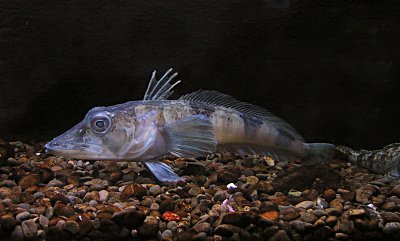
Which brought to mind my reaction to a recent BBC7 offering, the futuristic thriller Cold Blood. There was nothing original in the plot, but I could live with that. I followed along fine until we came to the “scientific” explosition. The homicidal villain of the piece was a scientist who found a cure for leukemia and pretty much everything else in the biology of the icefish (see left). In the best pulp tradition he self-administered his elixir and began turning into a human-icefish chimera, developing extreme cold tolerance and a tendency to rip out his coworker’s throats. He needed the iron from their blood because his was losing its hemoglobin. Icefish have none: oxygen dissolves better in cold water than warm, so they can survive in very cold water. Now, so I could accept psychosis (though that is probably even worse misrepresented in popular fiction than are genetics and genetic engineering) – say, toxic effects of his elixir. I could accept aplastic anemia or severe red blood dyscrasia or hemoglobin gene expression being turned off by insertion of a bioengineered vector – again toxic effects. But throw in cold adaptation sufficient for long-distance travel across the Antarctic at night PLUS a miracle cure for everything and the suspenders on my belief go pop-sproing! I can’t imagine history being presented, even as escapist entertainment, with such gross absurdities. (Though I am not an historian, and I do not know what torments historians suffer.) Why should SF!!