Category Archives: Science fiction

Con-Version 2003

The visitor to Calgary, at lest the one coming into the D-gates, is greeted by the ? I decided to dub it a femidactyl, or maybe a chickidactyl ? swooping out of the ? uhh ? fluorescent lights. Perhaps it was to honor the discovery of feathered dinosaurs, and the long sweeping metal columns linking it to its outriders of bat and eagle was an artistic impression of a taxonomic tree.

Calgary was hot and smoky with the drift from forest and grassfires; I wilted and was not nearly as social as I had wished to be, so saw little of Friday except the registration line-up. Saturday am I had a 10 am reading (is there ever a good time for a reading) with Lynda, where I read from “Suspended Lives”, a short story just published in Julie Czerneda?s Space Inc. anthology. If you’re at Worldcon, there will be a lanch party. Tell Julie I sent you. Lynda read the bit of The Courtesan Prince where a Reetion pilot (Ann) is improvising her way through the first official encounter with the Gelacks in centuries (including Amel). Subsequently I was on a panel on “Humans in Space”, where I felt like the lone technophile among social scientists; I had come prepared to speak on the medical challenges facing humans in space, whereas the panel went off in the direction of the political and social challenges facing the US (mainly) and the world of justifying space travel given the problems of earth. My reference, by the way, for a chunk of my research, is Frances Ashcroft’s Life at the Extreme: The Science of Survival on the subject of human adaptation to all extremes of environment, compared with other animal adaptation. Good panel, covered a lot of ground. My other panel was “Babylon 5: Five years after”, in which panelists and audience agreed that, yes, it was a great show, but disagreed on where exactly we would mark the point of it becoming great (do we hide the first, or the first and second seasons from people we would like to convert?), and whether fandom is its own worst enemy because we will point out the flaws and expect greatness. (Where I got hooked was Season 2, Episode 2, “Revelations”, which is not a bad place to pick it up. About half of the Season 2 episodes are well worth watching and watching again. And Season 3, yum!).
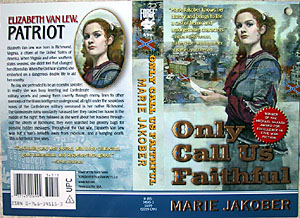
Events I attended were a reading by Dave Duncan from his forthcoming Blades’ novel Impossible Odds; the prologue is up at his website and this was Chapter 1, wherein one undistinguished and one too-young Blade are set an impossible task. Lynda has a photograph of Dave brandishing the cover. Marie Jakober had the paperback cover of her award-winning Civil War novel to show; that is also due out shortly. A preliminary, very small, image of the Edge edition of her fantasy Even the Stones is up at the Edge site. on the future books page. Dr. Phil Currie of the Royal Tyrell museum gave a talk on “Dinosaurs on SF”, complete with book covers ranging from pulp Edgar Rice Burroughs to Greg Bear’s Darwinia and Robert Sawyer’s Farseer series. Not to mention Jurassic Park. He filled us in on the behind-the-scenes of the feathered dinosaurs story and introduced us to some ofthe bestiary from the Alberta beds. I also heard Tim Hills talk about archery in SF, an expert free-associating about everything from bow design, styles of archery in various cultures, the sharpest points (obsidian, as shown by the researches of a surgeon enthusiast), the fastest fastshooter (2.1 s/arrow), the Mongol Ambassador outshooting the cream of English Bowmen in the ?Tudor years, Cape Buffalo hide …

CJ Cherryh's Foreigner series

I’m reading my way through the “Foreigner” sequence of books by CJ Cherryh. This is the main character, who functions as an intermediary between a human settlement on an alien planet and the aliens whose planet it is, thinking about the challenges of translation:

The paidhi had to have mathematical ability: it went with the job, and one learned it right along with a language that continually made changes in words according to number and relationship – sometimes you needed algebra just to figure the grammatically correct form of a set-adjective, when the wrong form could be infelicitous and offend the person you were trying to win. You formed sets on the fly in your conversation just to avoid divisible plural forms, like the dual or quad not offset by the triad or monad, and in learning rapid conversation, even with the shortcut concepts the language held, your head hurt – until you got to a degree of familiarity where you could chain-calculate while holding a conversation, and no restaurant ever got away with padding your bill. – CJ Cherryh, Invader

They’re fun books, with an extremely introverted presentation: they are entirely from the point of view of the lone human among aliens, who is obliged constantly to double-check and second-guess himself because not only is assassination common custom and betrayal an art-form, but the powerful bonds between atevi do not arise from liking or love, or anything humans have gut feeling for. Bren is forced into a constant intellectual analysis of everything internal and external, in the manner described by high-functioning autistics, who have to do consciously what the rest of us supposedly do by instinct (um. Maybe that’s why Bren’s ruminations are so entertaining: there but for the grace etc go I, thinks I, in certain highly social situations. Minus assassins. And alkaloid-laden teas). The alkaloid laden teas in question are ones he shares – in the first instance, nearly fatally – with one of the rare marvellous old ladies of SF, his main atevi ally’s grandmother and political rival, a hard-riding, wicked, shrewd old traditionalist who delights in making mischief. She is at various points in the books adversary, ally, and unknown quantity – usually the latter. He is at once very fond of her, and aware that she may well be the death of him, if he crosses her – or simply from a heart attack when she drops into a fraught situation and expects to carry all with sheer force of personality. There was an interesting review of one of the later books on SFSite where the reviewer remarks upon the introverted nature of the book and says that it makes sense if you interpret it (and the whole series) as an example of an atevi classical drama, a manchini play, in which the protagonists’ manchini (loyalty, allegence) is examined. Neat approach to taking the artist’s work entirely on its own terms.

Rustycon

It was the best of cons, it was the worst of cons … Well, maybe not, but it definitely had its ups and downs. Lynda’s suitcase, full of copies of Throne Price and the Rustycon edition of Mekan’stan, failed to make the 20 minute tranfer in Vancouver between a delayed flight from Prince George and the on-time flight to Seattle. Lynda’s end of the telephone inquisition required to connect her (not yet found) luggage to her gave her roommate (me) some morbid entertainment. The joys of Explaining Oneself to Officialdom – particularly when said officialdom don’t have it together. Luggage reappeared mid Saturday morning, and Lynda undertook to divest herself of the contents in as many deserving directions as possible, on the premise that if it went awol on the return flight there would be nothing to lose!

Lynda started out on Friday with “Making Characters Die” and “Writing a Sex Scene in SF”, which was where I tracked her down after I rolled in at 9:30 pm or thereabouts, having taken the 506 from SeaTac, and not having lost my luggage. Though I discovered that while having carry on baggage searched was irksome, having to walk the length of Vancouver airport, retrieve my luggage from within a glassed-in carosel, prove it’s mine, lug it through US Customs and Immigration, reload it onto a conveyer belt etc, was enough to convert me to the principle of carry on and only carry on until they develop Transporters.

My first panel was “Make those Characters Speak Up!” with: Lynda, Kevin Radthorne, who was showing off (cool plastic stand!) his novel The Road to Kotaishi, published by Windstorm press. He did the cover himself using Bryce, and if he is not being utterly disingenuous about his lack of artistic talent, I gotta have that program! Susan Matthews, who has finally produced another installment of her Judiciary series (so I get to [a] read about how Andrej Kosciusko finally gets to make his break with Fleet and his damnable – and I mean it literally – job as chief surgeon and inquisitor … and lands up in even more trouble and [b] update my Medicine and Science Fiction page). After I went through my recitation of various subtleties of dialogue, learned largely from Bernard Grebanier’s book Playwriting and my love of drama, she said cheerfully “I cheat,” tossed off an example of the shorthand that the writer can use, taking advantage of modern cultures and assumptions, and then took the high road and described the intricacies of her polyglot, multicultural Judiciary universe.

The next panel we spectated at, “Contracts: your rights as an artist, author, or musician”, a one-woman show by Jennifer DiMarco of Windstorm Creative, followed by “To POD or not POD”, featuring Jennifer (“Pods are evil!”) DiMarco, Kevin (“Born of a POD”) Radthorne, Dave (“Multipod”) Duncan, and Jack Beslanwitch (whose alignment I am afraid I cannot recall). Though until I see one of those infamous machines in action, I’m not going to believe all the descriptions I get of it lining and binding without getting glue over everything! After that Lynda, Kevin and myself did “Developing your Creativity” with an abundance of writers in the audience, so we wandered cheerfully between rituals, angst, and works in progress, as well as Where Ideas Come From. (I’m in favour of Pratchett’s cosmic ray theory myself: in Wyrd Sisters he explains creativity as a sleet of particles of inspiration constantly bombarding the human brain – which every so often stops one or two. Certain unfortunate people – like the Dwarf playwright Hwel – have such high stopping power that they have difficulty finishing a sentence without having another idea.)

(Two entries merged into one, September 30, 2007; original first date preserved).

The Hitchhiker's Guide to Galactic Medicine

You didn’t know that the first edition of The Hitchhiker’s Guide to the Galaxy had an terribly useful appendix entitled "A compendium of astro-travel medicine", did you? Its highlights, and its sad fate are detailed in the Christmas issue of the Canadian Medical Journal.

And it had me laughing until I wheezed in an empty office at 8 pm, 3 hours into overtime on zany deadlines with the computer system playing up. It is therapeutically funny.

On drunken conversations and metaphors

So we stayed up way too late and this morning my eyeballs didn’t just feel as though they’d been rolled in sand, but as though they’d been fried and then screwed back into too small sockets. But that is the price of two writers hanging on the phone until drunk with fatigue (because all that’s waiting for them once they let go of the night is sleep and the morning with students/meetings/study reports/children/work etc) talking about, among other things, the metaphors we use for the construction of a novel. At pushing 1 am I was not at all coherent in explaining my feeling-shape idea/sense/image. In the past I have made people laugh with my plaintive “But I’m not really a very verbal writer”, but I’m not. I know there are people out there who start with a picture, or with a character, or with – inexplicably – a plot, who just have to listen to some inner play or watch some inner movie. Lucky them! I start with something that is non-verbal, non-visual and pretty much nonsensical, something I have variously described as a tone or a sense-shape. One writer on creativity described this phenomenon as a feeling-tone, as what happened when a writer started with a recollection or an impression that would not reduce to straight narration. I have a very spatial relationship to my work. The real book is a shape in my head. I want the words to make me feel that shape in my head. As it goes up, I feel myself inside it, working to make it the right shape. I once talked to my mother about this, and she recognized exactly what I’m talking about; although not a writer, she conceptualizes in exactly the same way. Lynda’s word for what she desires in a scene is “muscular” – something that is doing work. And we both agreed that we also had a symphonic sense or metaphor for the emotional underpinnings to the work, though I think – I am not clear about this – that Lynda’s symphonic sense comes as she edits and starts putting dynamic and tempo to the development, and I am aware that I am building symphonically from the start, which probably explains why I write those 200 000 word first drafts with variant chapters peeling off the whole like arbutus bark as I move from – another metaphor, mathematical this time – first order to higher order narrative solutions. First order solutions are those I think anybody could come up with – good generic stuff. By the time I’m into third and fourth order solutions, I’m into the solutions I feel are particular to MY novel, which are made inevitable by the characters and the events I have portrayed. For me writing is like crystal structure refinement – or even more like building a solution from NMR data, rounds and rounds of least squares regression, fitting the words to the model, the shape in the head.